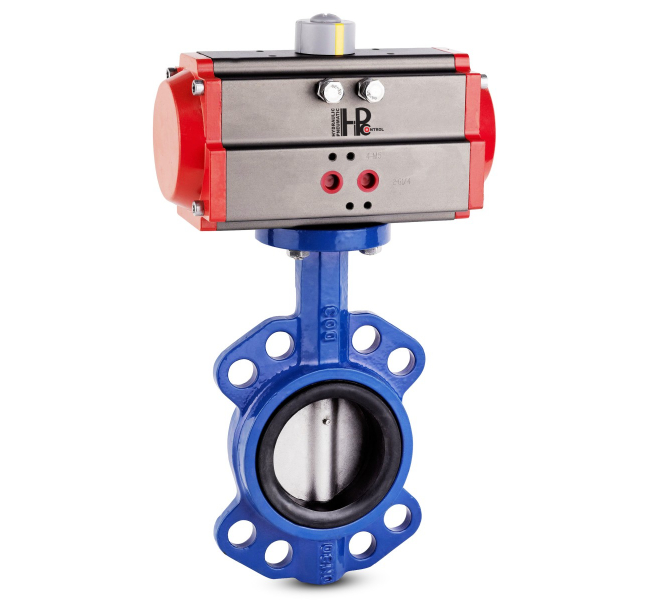
Pneumatic valve actuators are actuators that use air pressure to drive open, close or adjust valves. Pneumatic actuators are sometimes equipped with certain auxiliary devices, commonly used are valve positioners and handwheel mechanisms. The function of the valve positioner is to use the feedback principle to improve the performance of the actuator, so that the actuator can achieve accurate positioning according to the control signal of the controller.
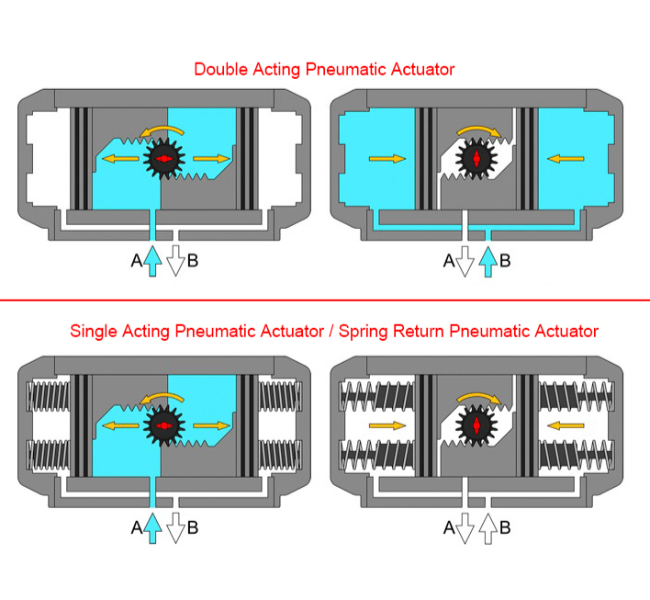
There are two types of pneumatic actuator working principle:
. Single acting pneumatic actuator working principle
. Double acting pneumatic actuator working principle
“The type of valve actuator you choose depends on your specific application. When it comes to deciding whether single- or double-acting actuators are right for your situation, the team at Winger can offer expert guidance and advice.” Winger
Single acting pneumatic valve actuator
Commonly referred to as spring-return actuators, a single-acting pneumatic actuator uses air to open the valve and a mechanical spring (or springs) to close the valve. The actuator can also be configured inversely so that air closes the valve and the spring is used to open the valve; this is called a normally-open configuration.
The most common reason single-acting actuators are chosen is for their reliable fail-safe design. This means that if power or air pressure is lost, the valve will quickly move to the normal position. This is useful in applications where serious consequences may occur if the valve remains open (or closed) when power and/or air pressure is lost..
Double acting pneumatic valve actuator.
Unlike single-acting actuators, double-acting actuators use air pressure to both open and close the valve.
This is the most popular style of pneumatic valve actuator. Double-acting actuators are selected for their lower cost and superior longevity, since the absence of mechanical springs in most models eliminates the least durable component in the actuator. It is not uncommon for a high-quality double-acting actuator to cycle millions of times before failing.
Prepare Documentation
Industry Standard Dummy
Brand Consistency
When to Use A Single-Acting Actuator Single acting actuators are common in low to moderate cycle applications where the valve failing in the wrong position could present a serious safety hazard and/or cause damage to nearby equipment. If power or air pressure is lost, single-acting actuators ensure that the valve will fail to the normal position. For this reason, single-acting actuators are the best choice when the simplicity and reliability of a safety system are of the utmost concern.
When to Use a Double-Acting Actuator Double-acting actuators are ideal for high cycle applications and/or applications where the valve failing to the closed (or open) position when power is lost does not present a critical issue. Double-acting actuators are the most popular choice for their lower cost and superior longevity. Double-acting actuators are also more compact than single-acting actuators and may be the only option in small form factor applications.